Appearance
Blueback Well Ties overview
The workflow for Blueback Well Ties begins with the selection of input well and seismic data, from the host application Petrel or Avary. Please consult the documentation for each for guidance on how to load data and launch Blueback Well Ties.
Cascading Parameterization
A key feature of Blueback Well Ties is its cascading parameterization, where any changes made during the workflow automatically update the entire workflow. The dynamic updates ensure consistency and reduces the need for manual recalibrations, thereby enhancing workflow efficiency and accuracy.
This structured approach to well tying not only streamlines the process but also enhances the overall precision and reliability of seismic interpretation workflows.
The repeatability of the tie workflow means that ties automatically update
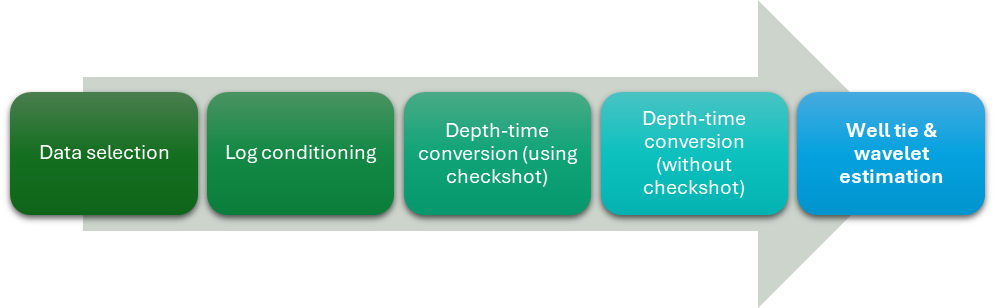
A summary of the Blueback Well Ties workflow.
Step 1: Log Conditioning
The software facilitates basic log conditioning tasks such as despike, log smoothing, and upscaling through Backus averaging. This initial step ensures that the data integrity is maintained and prepared for calculation of synthetic gathers.
Step 2: Time-Depth Relationship (TDR)
The next critical step involves calculating an initial Time-Depth Relationship (TDR). This is typically done using checkshots. In scenarios where checkshots are unavailable, alternative methods can be used, such as applying interval velocity volumes, using constant velocity values at the mudline (ML) and seawater, or matching well formation tops with seismic surfaces.
Step 3: Well-to-Seismic Ties
Once the initial TDR is established for all selected wells, the process moves to the well-to-seismic tie phase, which includes wavelet estimation when using the Roy White method.
Blueback Well Ties provides multiple methods for executing well-to-seismic ties:
- Cross-correlation bulk shift using the 'Adaptive' method from Simm & Chamberlin (2017).
- Roy White tie and wavelet estimation (White, 1980).
- Matching well tops to seismic surfaces.
- Manual tie, involving the selection of points on synthetic and seismic profiles (also known as stretch & squeeze).
- Fine tie options, which uses a variety of methods which tie the synthetic to the seismic sample by sample, using algorithms more commonly used for aligning 4D data or across angle stacks.
Step 4: Quality Control (QC)
The software generates comprehensive list of QC plots, statistics and maps to qualitatively and quantitively assed the quality of the tie. This ensures that each tie is optimized for accuracy.
Step 5: Wavelet Estimation and averaging
When the Roy White method is selected, the software estimates deterministic wavelets for each well and each input seismic volume. This provides high-resolution wavelet models that are critical for accurate seismic interpretation. The wavelets can be QC'd and averaged in the Wavelet QC step at the end of the workflow.
Step 6: Parameter Groups
When tying multiple wells at once, different group of wells may require different parameterisation to find the optimum tie. Parameter groups allow this, organizing into groups wells that require different settings in the various workflow steps such as log conditioning, time-depth relationships (TDR) calculation, alignment, and/or wavelet estimation. This feature helps tailor the workflow to the specific needs of each group of wells, improving flexibility and ensure more accurate results.