Upon launching, Blueback Well Ties defaults to Simple Mode. This mode is designed to streamline the well tying process by offering a comprehensive yet straightforward set of parameterization options. Simple Mode is ideal for quick tasks such as basic log conditioning, establishing initial Time-Depth Relationships (TDR), performing well-to-seismic ties with simple parametrization, and estimating wavelets.
The interface in Simple Mode is intuitive, making it accessible for both novice users and experts seeking to perform quick analyses. All options are clearly laid out, and guidance tooltips provide instant help to ensure users can make the most of each feature without needing to switch to more complex settings.
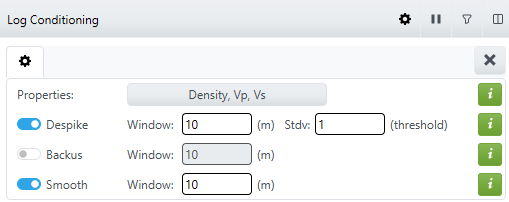
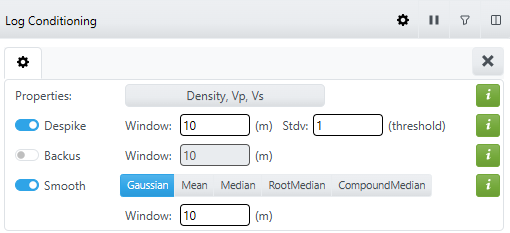
Users can easily apply basic conditioning techniques such as despike, and upscale logs using Backus averaging or smoothing logs by using a Gaussian filter. The image below shows the options in default mode.
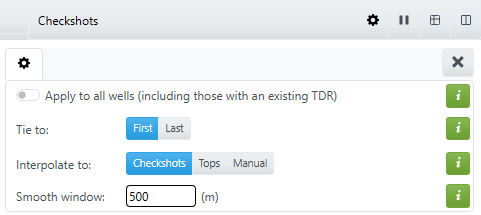
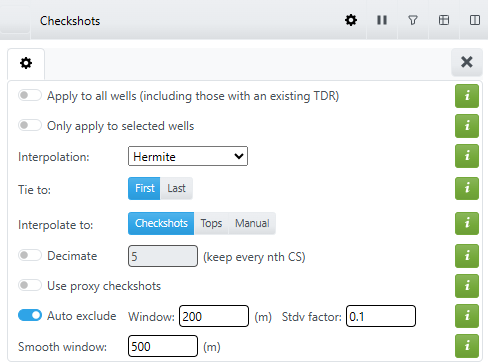
Calculate an initial TDR using checkshots. The options under 'simple' mode are:
Tying the checkshots to the first or last depth-time point.
Interpolate the drift using knee-points at checkshots points, selected well-tops or by manually entered depth values in MD.
Smooth window: the calculated TDR will be smoothed using a Gaussian smoother of the selected window size.
Time-Depth relationships using Checkshots in simple or default mode.
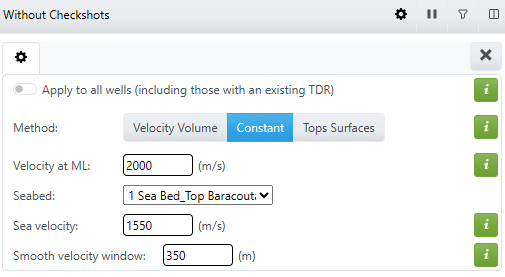
Time-Depth Relationship (TDR) -- Without Checkshots (simple)
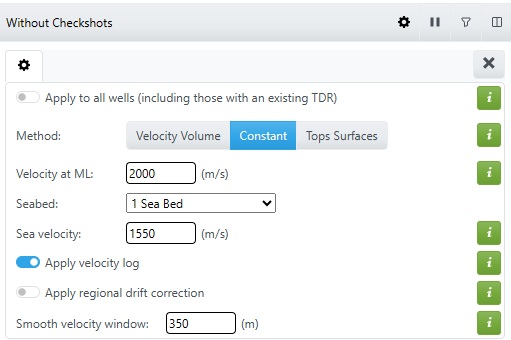
Calculate an initial TDR when checkshots are not available. The user has the option to calculate the TDR by using a velocity volume in depth, constant velocities below mudline (ML) and above seabed (when offshore), or by matching well formation tops with seismic surfaces.
Time-Depth relationships using Without Checkshots in simple or default mode.
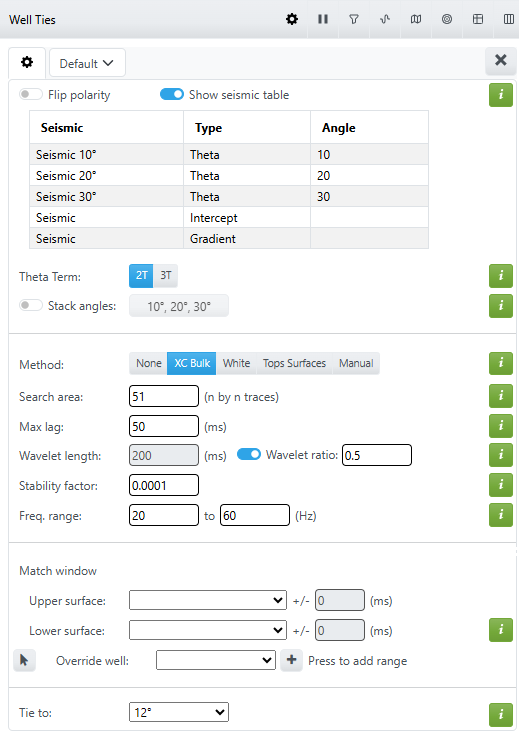
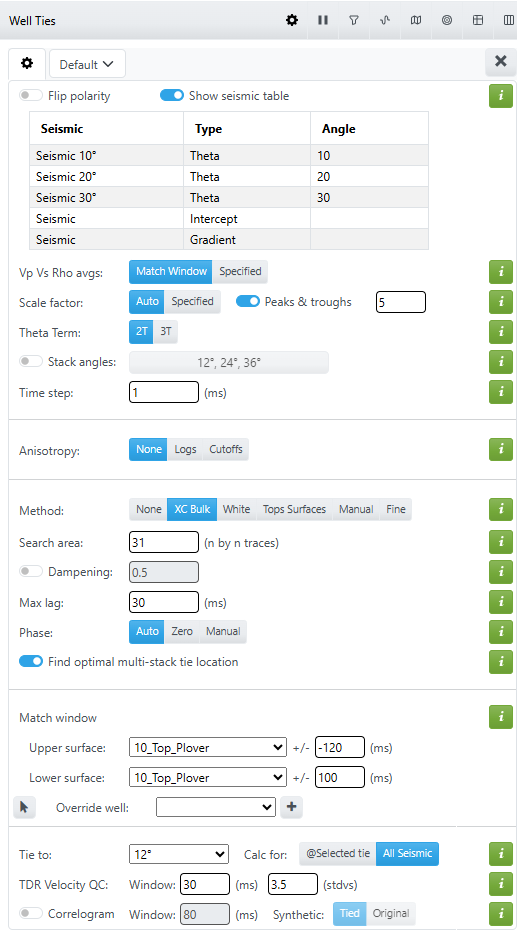
Execute essential tying operations using simplified options that ensure effective alignment between well logs and seismic data. Blueback Well Ties supports four different methods to perform a well tie.
This method creates a synthetic and compares it to the seismic data to find the time-shift and phase rotation which produces the best match. It does this by finding the cross-correlation between the seismic and synthetic, shifting the synthetic along the borehole, by up to the Max lag ms. The peak envelope of those XCs locates the time shift, and the difference between the peak XC and peak envelope the phase shift.
This method produces a single bulk shift of the well logs, it does not stretch or squeeze the TDR.
It is described fully in Simm & Chamberlain, 2017, as the Adaptive Technique, who recommend that the tie is performed in three stages:
An initial tie to find the phase of the seismic
Apply this rotation to zero-phase the seismic
Perform a zero-phase tie
White
This method finds the best match between reflectivity created from well log data and the seismic. The tie is made at the time shift which has the maximum cross-correlation. The tied reflectivities can then be used to derive a wavelet to match the seismic at that location. The wavelet will give an estimate of the frequency content and the phase of the seismic at the tie location.
Like XC Bulk, this method produces a single bulk shift of the well logs, it does not stretch or squeeze the TDR.
See White, 1980, and Walden and White, 1998, for further details.
Tops-Surfaces
The approximate time location of the wellbore can be found by pairing tops (in depth) and surface picks (in time) to create a TDR. There are options to snap the tops and surfaces to peak or troughs; typically the surfaces will have been picked on a peak or trough already, but the tops will likely have been selected based on well log data, so will need to be snapped to the synthetic so that it matches the seismic.
This method can be error prone, as it is not certain that a given seismic loop relates to a lithology contrast in the well log data, but it can produce a quick rough TDR for a well.
If more than one top-surface pair are used, this method can and will stretch and squeeze the data. Care must be taken not to create a TDR with unrealistic velocities.
Manual
Also known as ‘stretch & squeeze’, this method allows loops in the synthetic to be matched to equivalent loops in the seismic. The selected points can be snapped to the nearest peak or trough.
Like the Tops-Surfaces method, if more than one time-depth pairs are used, the stretch/squeeze must be properly QC'd.
If two or more manual points are added, the shifts can be smoothed using a Gaussian filter of the selected length.
For all methods other than White, the reflection coefficients calculated from the log data are convolved with the input wavelet to create the synthetic. This wavelet can be a statistical wavelet created by analysing the seismic data per stack, or a theoretical wavelet (e.g. Ormsby, Butterworth) which represents the seismic frequency response. Because of the differences between the Ricker wavelets and real seismic data, Ricker wavelets should not be used (Hoskin, 1998).
Well ties parameterization in simple or default mode.
If the ‘XC Bulk’ method is selected, the user will have three options to calculate the phase:
Auto - finds the phase difference and time shift simultaneously. If a constant phase difference across multiple wells is found it may mean the seismic needs to be phase corrected.
Zero - Assumes the seismic and wavelet are both zero-phase and finds the time shift to align the synthetic to the seismic.
Manual - Applies the selected phase rotation to the wavelet before creating the synthetic and then finds the time shift.
This allows the 3-step tie (find phase, rotate seismic, zero-phase tie) to be done easily.
Blueback Well Ties contains a number of salient QC metrics to assess the quality of each tie. These are displayed in the results table, opened by dragging the second icon from the right in the Well Ties banner into to the display area. In simple mode tools include:
Proportion of Energy Predicted (PEP): Assess how well the seismic data is predicted by the synthetic data generated from log information.
Time Shift Metrics: Evaluate the temporal alignment between the well data and seismic signals.
Phase Statistics: Check the phase coherence between synthetic and real seismic data.
Roy White Statistics: Analyze the quality of wavelets estimated using the Roy White method, ensuring they are suitable for the data set. QC statistics: L/T, bT, b/B, NMSE, where L = wavelet length, T = time window, B = seismic bandwidth, b = 1/L.
To access the advanced mode for Blueback Well Ties, select the option at the top right of the well ties session.
Blueback Well Ties advanced mode selector.
In advanced mode, the user has a full range of parameterization options to perform basic log conditioning, initial TDR, well-to-seismic tie and wavelet estimation. In this mode, the user has a complete range of QC statistics and maps, for instance, proportion of energy predicted (PEP), time shift, phase, and Roy white statistics to QC estimated wavelets.
Calculate an initial TDR using checkshots with additional options in advanced mode to select which wells to apply this to, select the drift interpolation type and to decimate the checkshots. For wells without checkshots, a nearby 'proxy' well can be selected, and the checkshots from that well used to create the TDR.
Time-Depth relationships using Checkshots in advanced mode.
Time-Depth Relationship (TDR) -- Without Checkshot (advanced)
Calculate an initial TDR using when checkshots are not available with additional options in advanced mode.
Time-Depth relationships Without Checkshots in advanced mode.
Execute more complex alignment operations, such as including anisotropy in the alignment, to ensure effective alignment between well logs and seismic data.
Well ties parameterization in advanced mode.
If Thomsen parameter logs (epsilon and delta) are available, they can be used to calculate anisotropic synthetic gathers to perform alignment and estimate wavelets. If logs are not available, petrophysical cut-off (VShale or GR) can be used to generate on-the-fly Thomsen parameter logs (epsilon and delta) by interpolating end-member values.
There are options to find the optimal tie location when multiple seismic volumes are being tied at the same time; the trace location which, on average, has the best tie for all seismic is selected.
There is also an option to using 'dampening' of the PEP used to find the best tie location. This favours trace locations nearest the well; if two locations have a similar PEP, the one nearest the well will be selected.
In advanced mode there are a number of extra Fine methods to enhance the tie. These methods are commonly used to align 4D data, but they can be used for well tie purposes too.
Weighted Time Shifts (WTS)
Cross correlation (XC)
Dynamic warping (DW)
Correlation leakage (CL)
Robust correlation leakage (RCL)
Non linear inversion (NLI) These methods gently stretch and squeeze the TDR to provide the optimal alignment, but should be used with care to avoid spurious ties. To work, there already needs to be a good alignment of the synthetic and seismic data, so are often best used as a second tie step, after and initial e.g. XC Bulk shift.
Well-to-seismic ties are a crucial step in seismic interpretation and inversion. Poor-quality well ties, especially those relying on qualitative methods, can significantly distort inversion results, affecting the estimation of elastic properties, with potential implications for reservoir characterization and drilling decisions.
To achieve an optimal well tie, it is essential to understand the true characteristics of the wavelet — specifically its amplitude, phase, and bandwidth, and how these properties vary with angle and spatially. A quantitative approach is critical; relying solely on visual comparisons between synthetics and seismic data, without objectively analysing the wavelet, is insufficient. Accurate wavelet estimation is a fundamental step toward ensuring the quality and reliability of the well tie (Aristimundo and Carvajal, 2022).
In Blueback Well Ties, deterministic wavelets are calculated using the well-known Roy White method, when the ‘White’ method is selected. This method uses coherence matching between synthetic (well data) and seismic traces. As quality control, this method calculates two main values, the Proportion of Energy Predicted (PEP), which is a measure of goodness-of-fit, where a value of 0.7 or higher is considered of good; and the Normalized Mean Square Error (NMSE), which is a mease of wavelet accuracy and where a value lower than 0.2 is considered good.
Other parameters used to quantify the quality of the estimated wavelets are bT (values between 5 and 12) and b/B (values between 0.25 and 0.5), where T = wavelet extraction time window, B = seismic bandwidth, b = 1/L and L = wavelet length.
In Blueback Well Ties, the following parameters affect the output wavelets:
Wavelet length: this can be set manually or automatically as a ratio of the estimation time window length.
Time window: for robust wavelet estimation on conventional seismic, the recommendation is a time window of at least 500ms (roughly 5 times wavelet length), that can be centred around a key horizon or surface, or two horizons or surfaces can be used to define the window.
In advanced mode, multiple tie steps can be used. This allows Well Ties to be daisy-chained. For example an initial Manual single bulk shift may be needed to move the well into the approximate time location, then a XC Bulk performed to refine the tie, followed by a White tie step to extract the wavelets. QC plots and tables for each can be displayed, and when the controls for one tie are changed, the values cascade; all the ties update.
To keep synthetic generation the same between tie steps (comparing apples with apples) the Vp Vs and Rho averages, the scale factor and the wavelets used can all be set to use the values from the previous tie step.
Aristimuno, J, and Carvajal, C., 2022. Well Tie Methodology: A Very Often Overlooked Critical Step in Seismic Interpretation and Inversion. CSEG Recorder, Vol. 47, No 01.
Hosken, J., 1998. Ricker wavelets in their various guises. First Break, Vol 6
Walden, A.T. and White, R.E., 1998, Seismic wavelet estimation: a frequency domain solution to a geophysical noisy input-output problem, IEEE Transactions on Geoscience and Remote Sensing 36, 287-297.
White R.E., 1980, Partial coherence matching of synthetic seismograms with seismic traces. Geophysical Prospecting 28, 333-358
White, R.E. & Hu, T., 1988. How accurate can a well tie be? The Leading Edge. Volume 17, issue 8.
White, R.E. & Simm R., 2003, Tutorial: good practice in well ties. First Break, Vol 21